AAPC CPC Practice Exam Fee | Test CPC Voucher
Wiki Article
BONUS!!! Download part of Exam4Free CPC dumps for free: https://drive.google.com/open?id=1hwk9NtxrlEXdZJ1wWyqbHxhkLvqPmEaR
Through all these years' experience, our CPC training materials are becoming more and more prefect. Moreover, we hold considerate after-sales services and sense-and-respond tenet all these years. So if you get any questions of our CPC learning guide, please get us informed. It means we will deal with your doubts with our CPC practice materials 24/7 with efficiency and patience.
AAPC CPC Exam Syllabus Topics:
| Topic | Details |
|---|---|
| Topic 1 |
|
| Topic 2 |
|
| Topic 3 |
|
| Topic 4 |
|
| Topic 5 |
|
| Topic 6 |
|
| Topic 7 |
|
| Topic 8 |
|
| Topic 9 |
|
| Topic 10 |
|
| Topic 11 |
|
| Topic 12 |
|
| Topic 13 |
|
| Topic 14 |
|
| Topic 15 |
|
| Topic 16 |
|
| Topic 17 |
|
>> AAPC CPC Practice Exam Fee <<
Test CPC Voucher, CPC Reliable Exam Pdf
In the process of using our CPC Study Materials if the clients encounter the difficulties, the obstacles and the doubts they could contact our online customer service staff in the whole day. If the clients fail in the test by accident we will refund them at once in the first moment. Our service team will update the CPC study materials periodically and provide one-year free update. We only use the certificated experts and published authors to compile our study materials and our products boost the practice test software to test the clients’ ability to answer the questions. The clients can firstly be familiar with our products in detail and then make their decisions to buy it or not.
AAPC Certified Professional Coder (CPC) Exam Sample Questions (Q414-Q419):
NEW QUESTION # 414
(Dr. Winston sees a patient with abdominal pain in the observation unit in the hospital. This is hisfirst visitwith this patient during this stay. He spent a total time of85 minuteson that patient on that date of service, including review of the observation admission, labs, X-rays, and EKG results, and examining the patient with amoderate level of medical decision making. What CPT coding is reported?)
- A. 99223, 99418
- B. 0
- C. 99222, 99418
- D. 1
Answer: D
Explanation:
This is aninitial hospital/observation evaluation(first visit during the stay), so the correct code family is theinitial observation/inpatient E/Mlevel. The stem providestotal time = 85 minutesand also statesmoderate MDM. Under current E/M rules, you can select the code based oneither MDM or total time(when time is used, it includes the physician's qualifying time on that date). The time of85 minutesfits the time range for99223(the highest initial hospital/observation level by time) even if MDM is described as moderate. The prolonged service add-on99418requires meeting the threshold beyond the primary code's time before it can be added; with 85 minutes, you do not reach the additional increment needed to report 99418. Therefore, you report99223 only. CPC exam tip: when time is explicitly provided and is high, it often drives the level; do not add prolonged time unless the documented time clearly exceeds the primary code's requirement by the necessary increment.
NEW QUESTION # 415
A 60-year-old male suffering from degenerative disc disease at the L3-L4 and L5-S1 levels was placed under general anesthesia. Using an anterior approach, the L3-L4 disc space was exposed. Using blunt dissection, the disc space was cleaned. The disc space was then sized and trialed. Excellent placement and insertion of the artificial disc at L3-L4 was noted. The area was inspected and there was no compression of any nerve roots. Same procedure was performed on L5-S1 level. Peritoneum was then allowed to return to normal anatomic position and entire area was copiously irrigated. The wound was closed in a layered fashion. The patient tolerated the discectomy and arthroplasty well and was returned to recovery in good condition. What CPT coding is reported for this procedure?
- A. 0
- B. 1
- C. 22857 x 2
- D. 22857, 22860
Answer: D
NEW QUESTION # 416
A 3-day-old died in her sleep. The pediatrician determined this was the result of crib death syndrome. The parents give permission to refer the newborn for a necropsy. The pathologist receives the newborn with her brain and performs a gross and microscopic examination. The physician issues the findings and reports they are consistent with a normal female newborn.
What CPT code is reported?
- A. 0
- B. 1
- C. 2
- D. 3
Answer: D
Explanation:
* Procedure: Gross and microscopic examination of a newborn autopsy.
* CPT Code:
* 88028: This code is for the autopsy, gross and microscopic examination of a stillborn or newborn.
* Code Selection Justification: The procedure described matches the comprehensive postmortem examination of a newborn.
References:
* AMA CPT Professional Edition (current year)
* ICD-10-CM (current year)
* HCPCS Level II (current year)
NEW QUESTION # 417
View MR 001394
MR 001394
Operative Report
Procedure: Excision of 11 cm back lesion with rotation flap repair.
Preoperative Diagnosis: Basal cell carcinoma
Postoperative Diagnosis: Same
Anesthesia: 1% Xylocaine solution with epinephrine warmed and buffered and injected slowly through a 30- gauge needle for the patient's comfort.
Location: Back
Size of Excision: 11 cm
Estimated Blood Loss: Minimal
Complications: None
Specimen: Sent to the lab in saline for frozen section margin control.
Procedure: The patient was taken to our surgical suite, placed in a comfortable position, prepped and draped, and locally anesthetized in the usual sterile fashion. A #15 scalpel blade was used to excise the basal cell carcinoma plus a margin of normal skin in a circular fashion in the natural relaxed skin tension lines as much as possible The lesion was removed full thickness including epidermis, dermis, and partial thickness subcutaneous tissues. The wound was then spot electro desiccated for hemorrhage control. The specimen was sent to the lab on saline for frozen section.
Rotation flap repair of defect created by foil thickness frozen section excision of basal cell carcinoma of the back. We were able to devise a 12 sq cm flap and advance it using rotation flap closure technique. This will prevent infection, dehiscence, and help reconstruct the area to approximate the situation as it was prior to surgical excision diminishing the risk of significant pain and distortion of the anatomy in the area. This was advanced medially to close the defect with 5 0 Vicryl and 6-0 Prolene stitches.
What CPT coding is reported for this case?
- A. 0
- B. 14001, 11606-51, 12034-51
- C. 14001, 11606-51
- D. 1
Answer: C
Explanation:
For the excision of an 11 cm lesion with a rotation flap repair, the appropriate CPT codes are 14001 for the adjacent tissue transfer or rearrangement (12 sq cm flap) and 11606-51 for the excision of a malignant lesion including margins, face, ears, eyelids, nose, lips; excised diameter over 4.0 cm. Modifier 51 indicates multiple procedures. The detailed operative report specifies the lesion size and the technique used, justifying these codes.
References: CPT Professional Edition (current year), AMA.
NEW QUESTION # 418
Refer to the exhibit.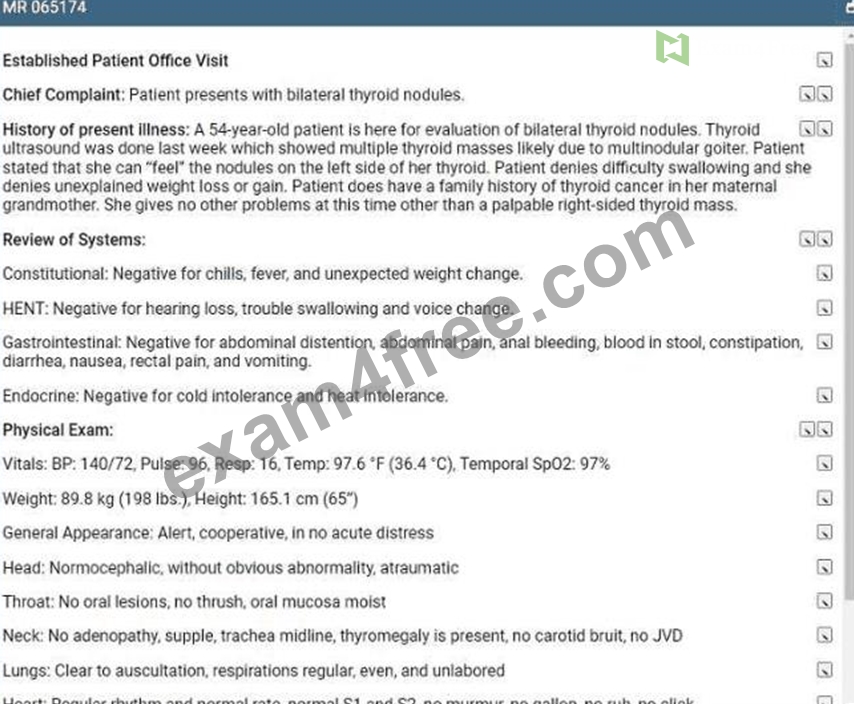
Refer to the supplemental information when answering this question:
View MR 065174
What E/M code is reported for this encounter?
- A. 0
- B. 1
- C. 2
- D. 3
Answer: A
Explanation:
To determine the correct E/M code, we need to consider the three key components: history, examination, and medical decision making (MDM).
History:
The documentation indicates an expanded problem-focused history. This is supported by the detailed history of present illness, including the patient's description of symptoms, family history, and review of systems with pertinent positives and negatives.
Examination:
The examination is also expanded problem-focused. The physician focused on the relevant systems (head, neck, throat) and documented specific findings related to the chief complaint (thyromegaly).
Medical Decision Making:
The MDM is straightforward. The physician is evaluating a new problem (bilateral thyroid nodules) with a low level of risk. Although further workup is planned, this alone doesn't automatically increase the MDM complexity.
Based on these components, 99213 is the most appropriate code.
Why other options are incorrect:
99212: Requires a problem-focused history and examination, which is less comprehensive than what was documented.
99214 and 99215: Require a higher level of MDM (low or moderate complexity) and/or a more detailed examination. The documentation doesn't support this level of service.
Reference:
CPT Codes 99211-99215: Office or other outpatient visit for the evaluation and management of an established patient
1995 and 1997 Documentation Guidelines for Evaluation and Management Services: These guidelines provide detailed criteria for selecting the appropriate E/M code based on history, examination, and MDM.
AAPC Coder's Desk Reference: This resource provides detailed information on coding guidelines and procedures.
NEW QUESTION # 419
......
Our CPC cram materials take the clients' needs to pass the test smoothly into full consideration. The questions and answers boost high hit rate and the odds that they may appear in the real exam are high. Our CPC exam questions have included all the information. Our CPC cram materials analysis the popular trend among the industry and the possible answers and questions which may appear in the real exam fully. Our CPC Latest Exam file stimulate the real exam's environment and pace to help the learners to get a well preparation for the real exam in advance.
Test CPC Voucher: https://www.exam4free.com/CPC-valid-dumps.html
- Free CPC Test Questions ???? Reliable CPC Exam Topics ???? CPC Certification Exam ???? Search on 《 www.validtorrent.com 》 for ➠ CPC ???? to obtain exam materials for free download ⌛Reliable CPC Exam Topics
- Free CPC Test Questions ???? Free CPC Test Questions ???? New CPC Exam Topics ???? Easily obtain free download of ⏩ CPC ⏪ by searching on ✔ www.pdfvce.com ️✔️ ????New CPC Exam Topics
- Valid CPC Test Blueprint ➿ Reliable CPC Test Experience ???? CPC Valid Exam Online ???? Easily obtain ✔ CPC ️✔️ for free download through ➡ www.prepawaypdf.com ️⬅️ ????Reliable CPC copyright
- CPC actual exam torrent - CPC practice materials - CPC valid practice material ???? Search for ➡ CPC ️⬅️ and obtain a free download on ➤ www.pdfvce.com ⮘ ????New CPC Exam Topics
- Reliable CPC copyright ???? CPC Valid copyright Free ???? CPC Exam Sample Questions ???? Easily obtain free download of ▷ CPC ◁ by searching on ➠ www.testkingpass.com ???? ????CPC Frequent Updates
- Pass Guaranteed Pass-Sure AAPC - CPC - Certified Professional Coder (CPC) Exam Practice Exam Fee ???? Copy URL ➥ www.pdfvce.com ???? open and search for ⮆ CPC ⮄ to download for free ⬛Training CPC Materials
- Use Latest AAPC CPC Dumps For Smooth Preparation ???? Search for ✔ CPC ️✔️ and download exam materials for free through 「 www.pdfdumps.com 」 ????CPC Valid copyright Free
- CPC Valid Exam Online ???? Instant CPC Access ???? Valid CPC Test Blueprint ???? The page for free download of ▶ CPC ◀ on “ www.pdfvce.com ” will open immediately ????CPC Examcollection Dumps Torrent
- CPC actual exam torrent - CPC practice materials - CPC valid practice material ???? Download [ CPC ] for free by simply entering 【 www.verifieddumps.com 】 website ⛲New CPC Exam Topics
- CPC Frequent Updates ???? Latest CPC copyright Files ???? CPC Certification Exam ???? Download ⇛ CPC ⇚ for free by simply entering ▛ www.pdfvce.com ▟ website ❇Trustworthy CPC Exam Content
- Composite Test CPC Price ???? Trustworthy CPC Exam Content ???? New CPC Exam Topics ???? Easily obtain ✔ CPC ️✔️ for free download through ⮆ www.dumpsquestion.com ⮄ ????CPC Valid Exam Online
- www.stes.tyc.edu.tw, ezekielsbxd816635.anchor-blog.com, denisxwib154270.wikiexcerpt.com, my-social-box.com, aadamiiyw063771.blog4youth.com, total-bookmark.com, bookmarklethq.com, blanchekekq340616.tkzblog.com, tamzinbvpc257411.elbloglibre.com, altbookmark.com, Disposable vapes
DOWNLOAD the newest Exam4Free CPC copyright from Cloud Storage for free: https://drive.google.com/open?id=1hwk9NtxrlEXdZJ1wWyqbHxhkLvqPmEaR
Report this wiki page